
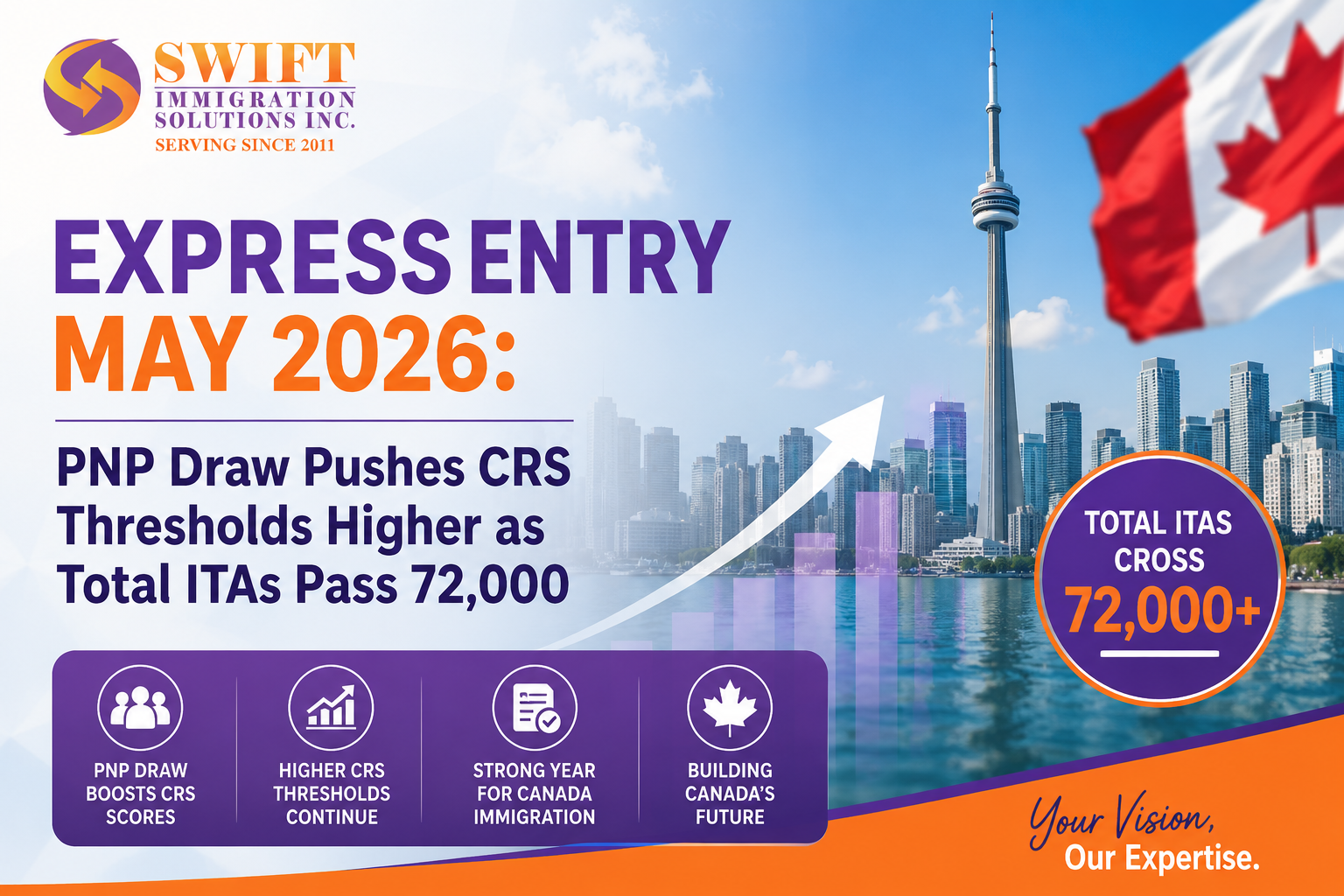
The structural trajectory of Canadian immigration in 2026 continues to heavily favour domestic, highly integrated applicants. On May 11, 2026, Immigration, Refugees and Citizenship Canada (IRCC) conducted its twenty-seventh Express Entry selection of the year, focusing exclusively on the Provincial Nominee Program (PNP).
This latest draw reinforces a year-long trend: IRCC is heavily managing its intake by selecting candidates who already have established roots, employment, or provincial backing within Canada, aligning closely with current infrastructure and housing strategies.
The May 11 Draw: High Cutoffs for Provincial Nominees
The first draw of May issued 380 Invitations to Apply (ITAs) to candidates with a provincial nomination. Because an active provincial nomination automatically injects 600 points into a candidate’s Comprehensive Ranking System (CRS) profile, the minimum thresholds for these draws are characteristically high.
- ITAs Issued:380
- CRS Cut-off Score:798
- Tie-breaking Rule:January 7, 2026, at 5:23 a.m. UTC
A CRS cutoff of 798 indicates that the baseline profile score required before the provincial nomination bonus was just 198 points. This makes PNP draw an incredibly viable path for candidates who have lower core CRS scores but possess the specific regional skills or local job offers that individual provinces are looking for.
2026 Year-to-Date: Mid-Year Distribution Data
With the completion of the May 11 draw, IRCC has now issued a total of 72,007 ITAs across 27 distinct selections in 2026. The breakdown of these invitations across various pathways highlights where the federal government is focusing its resources.
Total ITAs Issued by Stream (2026)
| Draw Type | Total ITAs Issued | Number of Draws |
| Canadian Experience Class (CEC) | 34,250 | 8 |
| French-Language Proficiency | 26,000 | 5 |
| Provincial Nominee Program (PNP) | 4,116 | 10 |
| Healthcare and Social Services | 4,000 | 1 |
| Trades | 3,000 | 1 |
| Physicians (with Canadian Experience) | 391 | 1 |
| Senior Managers (with Canadian Experience) | 250 | 1 |
The Dominance of CEC and French Categories
The Canadian Experience Class (CEC) remains the leading stream for obtaining permanent residency in 2026, accounting for roughly 47.5% of all ITAs issued. This aligns directly with IRCC’s explicit domestic prioritization strategy, ensuring temporary foreign workers and international graduates already residing in Canada have a clear pipeline to permanent status.
Concurrently, the French-Language Proficiency stream continues its historic run. With only 5 draws compared to the PNP’s 10, it has commanded 26,000 ITAs—evidencing massive, high-volume selections that occur when French draws are called (averaging over 5,000 ITAs per draw).
Macro Trends: The Emerging Two-Tiered Express Entry
An analysis of the 2026 draw history shows a widening divergence in what it takes to secure an ITA, splitting the Express Entry pool into two distinct pathways.
1. High-Barrier Paths (CEC and PNP)
For standard applicants residing in Canada without category-based targeted attributes, the barriers to entry remain historically high. The “floor” for standard CEC draws has risen slightly from its early-year markers, hovering at 514–515 in late April. Securing an ITA here requires an exceptional profile: maximum language scores, youth points, and often a combination of foreign and Canadian education or work experience.
2. Strategic “Fast Tracks” (French, Trades, and Healthcare)
Conversely, category-based selection remains an accessible lifeline. Candidates clearing thresholds in targeted categories are seeing significantly lower requirements:
- French-Language Proficiency:Cutoffs stabilized at 400 in the April 29 draw.
- Trades:A massive single draw of 3,000 ITAs on April 2 dropped the cutoff to 477.
- Healthcare:Stabilized well below general scores at 467.
Understanding the “In-Land” Selection Rationale
Why the heavy focus on the PNP (10 draws) and CEC (8 draws)? By focusing on applicants who are already living, working, and paying taxes within provincial jurisdictions, IRCC can successfully achieve its annual immigration targets while mitigating immediate, sudden pressures on local real estate markets and healthcare infrastructures. These applicants are already integrated into the housing and economic fabric of their respective communities.
Strategic Considerations for Candidates
If you are navigating the Express Entry pool in mid-2026, the data points to clear strategic pivots:
- Pursue Provincial Nominations Aggressively:With 10 draws completed, the PNP is the most consistently active program of the year. Align your profile with specific provincial streams (like Ontario’s Human Capital Priorities or BC’s Tech Stream).
- Maximize Category Targets:If you have intermediate French capacities or work in a skilled trade, dedicating effort to clear NCLC 7 or obtaining Canadian trade certification yields a much higher return on investment than attempting to grind out a few extra points on a general CEC profile.
Conclusion: A Highly Calculated System
The May 11 draw confirms that Express Entry in 2026 operates like a surgical instrument rather than a wide net. With over 72,000 invitations extended, Canada is welcoming talent at a steady pace—but only under terms that directly serve provincial economies and strategic linguistic goals.
Want to see where your profile fits within the current 2026 metrics?
- Calculate your current CRS scoreusing the updated 2026 benchmarks.
- Evaluate provincial nomination pathwaysacross Ontario, Alberta, and British Columbia.
- Review French-language assessment parametersfor targeted category selection.
For all your immigration needs, and to ensure you are positioned correctly for these upcoming changes, visit Swift Immigration. Whether you are applying under the current programs or preparing for the new unified class, professional guidance is the key to a successful journey to Canada.